


Anyone who deals with website management and search engine positioning knows how valuable it is in analyzing the performance of a website to know what the influence of the organic results on search engines was in the production of visits, and for those who invest in SEO it is very useful to know what results have been obtained, and which keywords work better than others.
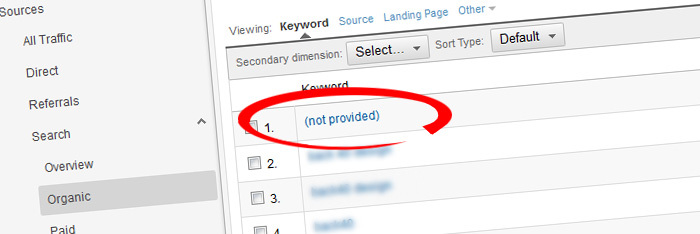
This information was traditionally made available to us by Google Analytics in its "Organic Results" tab in the "Traffic Sources" section. In this report, however, for some time now we have become accustomed to seeing the wording (not provided) among the list of keywords. However, this non-keyword concerned an overall negligible part of the visits, and therefore could easily be ignored. In recent times, however, the volume of visits from search engines classified as “not provided" is dramatically increasing.
What is the keyword (not provided)?
The “not provided” result of Analytics is due to the use of the SSL protocol for the connection of all users who have logged in to any of the services offered by Google (Gmail, Google+, YouTube, etc.) and perform then some web searches. Under the auspices of protecting the privacy of these users, Google has therefore decided to no longer make information on the searches they have performed available.
But upon closer inspection, it is not only searches carried out by logged in users that are obfuscated. Because even once logged out of Google services, the user continues to remain in a safe browsing context, with the https protocol and therefore with an encrypted connection, with the result that his searches will continue not to be displayed, although the user is no longer connected and therefore recognisable.
Lately, both Firefox and Chrome automatically redirect their users to an https protocol when the Google address is typed, or when a search is carried out via their respective search boxes. Also in this case the consequence is that any search carried out using the two browsers inevitably ends up being classified as "not provided".
To anyone involved in web analytics it is clear that the number of "not provided" keywords is dramatically growing, involving particularly significant search volumes, with peaks of up to 80% and the consequent total uselessness of the Keywords report. To get an idea of the dimensions the topic has now reached, we recommend a visit to the website www.notprovidedcount.com,which among other things estimates that for some sites already by the end of November 2013 100% of the keywords could be classified as “not provided”.
How can the problem be solved?
Coincidentally, these good intentions on protecting user privacy do not apply to (paid)AdWords campaigns and therefore sites that use this product will continue to have access to the lists of keywords entered by users who click on the ads. This has led some to argue that in this way Google has put a price on protecting the privacy of its users.
For all those who do not have an active AdWords campaign on their site, all that remains is to try to find an alternative solution. There are many tips online to try to get around the problem, some even very sophisticated, but none of them manages to solve the problem definitively.